
4 advantages (and 1 disadvantage) of desiccant dehumidifiers
Feb 20, 2025High humidity can be unpleasant. If you're choosing a dehumidifier, this brief overview of the advantages and disadvantages...
Can you get a Wi-Fi weather station with a smart internet weather forecast for just € 60? We tested the Airbi FORECAST to find out whether its low price means compromises on features.
The home weather station market usually follows a simple rule: if you want Wi-Fi connectivity and an internet-based forecast, you have to spend more. The Airbi FORECAST challenges that rule. It offers a 5-day internet forecast, up to three wireless sensors with a 100-metre range, and control through the Tuya Smart mobile app. Its price is about what other brands charge for a basic, non-smart station.
| PROS | CONS |
|
|
The packaging is simple but complete. You get the indoor unit, a power adapter, one outdoor sensor and a user manual. Both the station and the sensor have a stand and a hole for wall mounting, so you can place them wherever suits your space.
All the buttons are on the top edge of the station, which is a practical design. On devices with buttons on the back or below the display, you have to lift or turn the unit. Here you just reach over the top with one hand.
The indoor unit runs primarily on mains power (the adapter is included) and has batteries as backup in case of a power cut. If the adapter loses power, the Wi-Fi functions stop: the forecast won't update and measured temperatures won't be sent to the app. The outdoor sensor runs only on batteries.
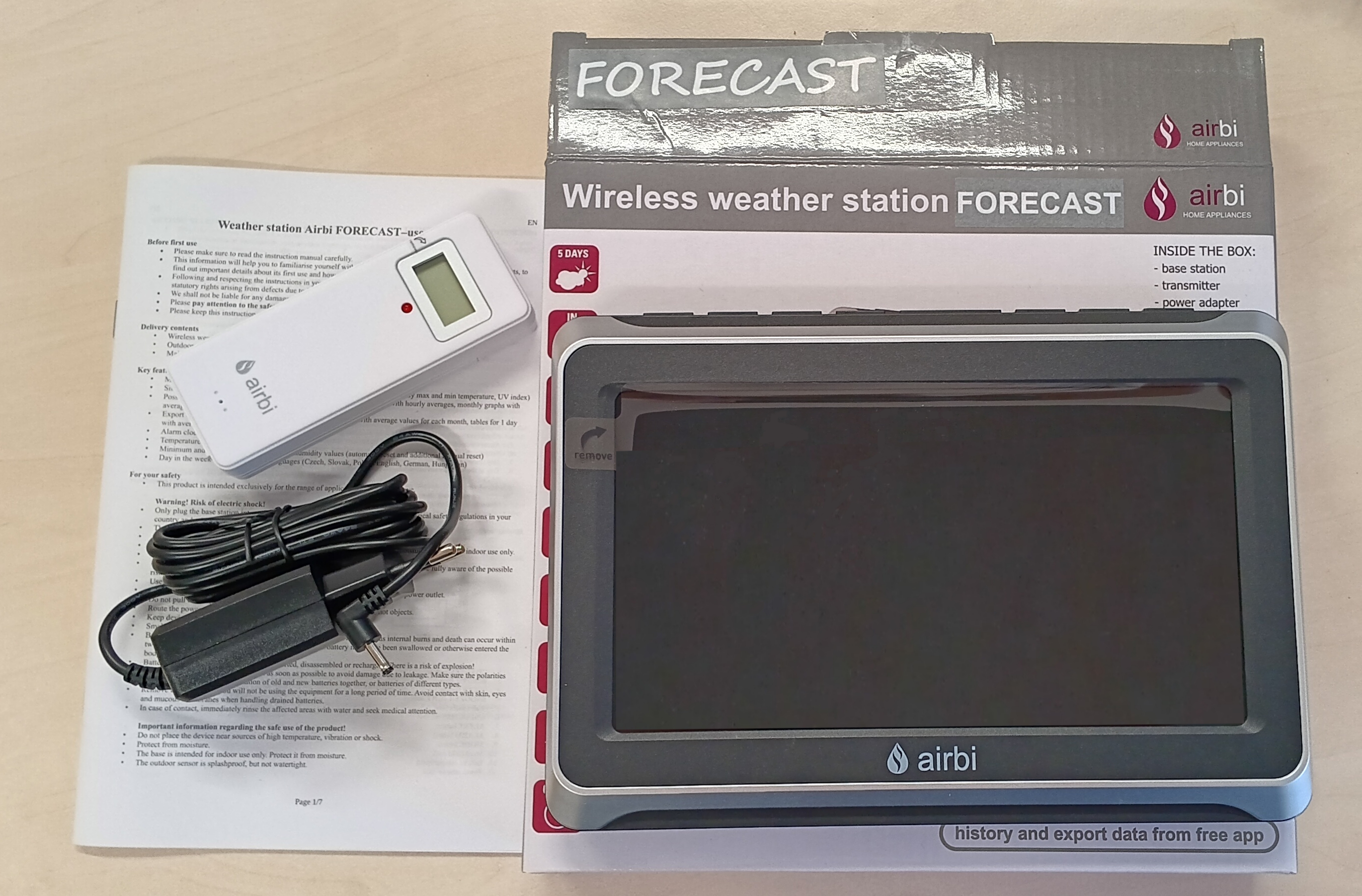
The box contains the indoor unit, the outdoor sensor, a power adapter and a multilingual manual (including Czech).
Setup has two stages. First, you pair the wireless sensor with the station. The printed manual explains this clearly, so even less technical users can manage it. Then you connect the station to your home Wi-Fi network (note: 2.4 GHz band only) and pair it with the Tuya Smart app.
Both the app and the manual guide you through the whole process. If you use a smartphone regularly, you can set it up without help. Once setup is complete, the display immediately shows the current time, the date and a five-day forecast. You can also use the station's buttons to change the language of the day-of-week abbreviation.
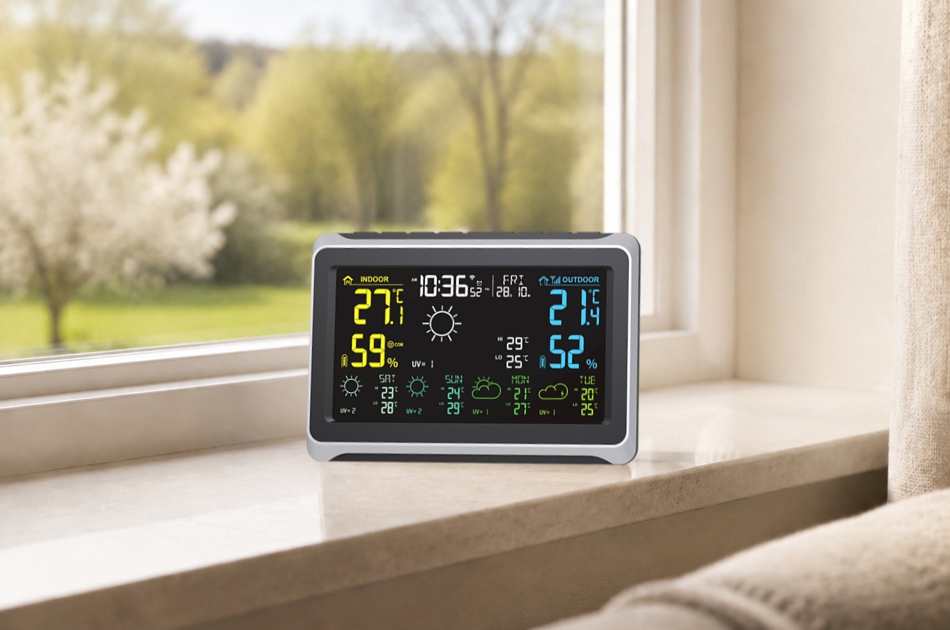
The 7-inch backlit inverted display is easy to read, even from an angle. It shows indoor and outdoor temperature and humidity. One sensor comes in the box, but the system supports up to three sensors at once, so you could monitor for instance your bedroom, garden and garage at the same time. A maximum range of 100 metres in open space is among the best in this price category.
As you'd expect, the display shows the time, date and day of the week. This is where the language localisation is useful, because the day abbreviation appears in your chosen language (available languages are Polish, Czech, Slovak, Hungarian, German and English).
One interesting detail is how the clock is set. Classic weather stations synchronise via the DCF radio signal, which is often unreliable and needs the station to be near a window. The Airbi FORECAST synchronises over the internet instead. As long as it has a Wi-Fi signal, the time is always accurate and switches between summer and winter time automatically.
As a bonus, there is an alarm clock with three separate wake-up times. For each one, you can choose the days it applies to: weekdays, weekends or every day.

The station shows indoor temperature and humidity (top left) and outdoor readings (top right). The time, date, day of the week and alarm icons are at the top centre.
The 5-day forecast fills the middle and lower parts of the screen.
What sets the Airbi FORECAST apart from ordinary "dumb" weather stations is where its forecast comes from. Classic stations calculate their own predictions from their atmospheric pressure readings. That's why they show only a simple symbol, why they are correct only about 70% of the time, and look only 12–24 hours ahead. The Airbi FORECAST downloads a finished forecast from an online service, where meteorologists prepare it using supercomputers and data from a global network of weather stations. This makes the forecast much more accurate and detailed.
You get a 5-day forecast, and each day shows:
When we compared the forecasts with other weather services, they differed by 0–2 °C, which is more than accurate enough for home use. Day to day, the station reliably tells you whether you'll need an umbrella, a jacket or sunscreen, without checking your phone or waiting for the TV forecast.
(Please note: for demanding activities such as mountain hiking, flying or sailing, we still recommend checking specialised sources as well, such as dedicated weather apps. When the weather can change suddenly, it makes sense to have several sources and more detailed information.)
The station continuously assesses the indoor climate. A simple smiley icon shows whether the room's temperature and humidity are comfortable. The daily minimum and maximum temperatures reset every night at midnight and are recorded again.
Remote control and data monitoring are handled by the Tuya Smart app, available for Android and iOS. It was originally developed for a wider smart home system. The app offers:
The app's main weakness comes from its general smart home focus: it works only with averaged data. Charts and tables show hourly or daily averages, not exact minimums and maximums over shorter periods. This is usually enough for normal home use. If you need to monitor fast-changing conditions in more detail (e. g. for food or drugs storage), though, a more specialised system is worth considering.
The paid advanced features for connecting the station with other Tuya smart home devices were not part of this test.
The Airbi FORECAST shows that an affordable weather stationcan offer an internet forecast and smart features that until recently were found only on more expensive models. An accurate five-day forecast, reliable readings from up to three long-range sensors and a practical app make a solid package that most households will appreciate.
The limits show where demanding users are concerned. The station has no support for wind sensors or rain gauges, and the app doesn't provide detailed (non-averaged) data. Serious amateur meteorologists should therefore look at semi-professional or professional stations, which start at around € 160.
Who is it for? It's ideal for anyone who wants a quick overview of current and upcoming weather without picking up their phone. It's especially well suited to flats and apartment blocks, where wind or rain sensors wouldn't make sense anyway. For the features it offers, it's clearly a good buy.